
By Robert J. Cadranell, originally published in the May 1988 Arabian Visions magazine.
With the exception of one small line, which accounts for some eleven living horses, all currently living 100 percent Davenport individuals trace to their ancestry in every line through the W.K. Kellogg Arabian Horse Ranch back to the original 1906 Davenport imports.
In other words, if one were to take the pedigree of most any living Davenport horse and work backwards toward 1906, generation by generation, no matter what route one took one would run into Kellogg animals.

From the beginning of Mr. Kellogg's Arabian horse breeding venture in 1925 until the death of the stallion Jadaan in 1945, the Kellogg Ranch owned, bred, or acted as agents in the sale of no fewer than 45 horses falling into the 100 percent Davenport category (100 percent Davenport horses, or "Davenports" being defined as those animals originally registered by the Arabian Horse Registry of America as imported directly to America from Arabia in 1906 by Mr. Homer C. Davenport, and by extension, animals bred exclusively from his foundation).
The bloodlines in current Davenport pedigrees which arrived at the Kellogg Ranch had left the Hingham Stock Farm in three large batches, eventually arriving in Pomona. This progression is seen in figure 1.
The horses of F.E. Lewis II left the Hingham Stock Farm first, ownership having been transferred on August 22, 1918. This band of Hingham bloodstock Lewis brought to his Diamond Bar Ranch in Spadra, California.
The mares included Hasiker (*Hamrah/*Reshan), Tamarinsk (*Hamrah /*Werdi), Moliah (*Hamrah/*Wadduda), and *Saleefy (*Haleb/*Urfah). The stallions were Harara (*Deyr/*Haffia) and Letan (*Muson/*Jedah). The horses worked cattle, and the Diamond Bar mare band produced several foals a year.
Next, in September of 1921, Mr. & Mrs. John Gilbert Winant purchased a large number of Arabians from the Hingham Stock Farm. According to the Winant biography, He Walked Alone, the Winants were at this time newly married.
Mr. Winant was later to become Governor of New Hampshire and then U.S. Ambassador to Great Britain. The horses transaction included, *Hamrah, *Haffia, Sheria (*Abbeian/*Urfah), and Sankirah (*Hamrah/Moliah). *Haffia had a filly at foot named Poka (by *Hamrah).
Sankirah was in foal to *Deyr. In less than a year, the Winants sold most of their Arabians to Morton S. Hawkins of Indiana, including *Haffia, Saba, Poka, and Sankirah, the latter by this time with her colt Hanad at foot. Hawkins was unable to keep most of the horses, which were scattered.
Saba, Poka, Sankirah, Hanad, and others ended up in the hands of Charles W. Jewett of Indianapolis, one time mayor of that city.
The third large batch of horses went directly form the Hingham Stock Farm to southern California. This time the buyer was a man named Chauncey D. Clarke, who was working with the most interesting German fellow by the name of Carl Schmidt.
Schmidt is better known by the name he assumed when naturalized as an American citizen: Carl Raswan. In a letter dated December 6, 1948, Raswan tells the story to Alice Payne, a lady who will always be remembered as the last owner of *Raffles and *Raseyn and for her concentrated *Raffles breeding.
When I first started out in the USA (1921 I came here) I made an effort to save the priceless Davenport blood first - and so, in 1924 I succeeded to collecting (with Mr. Chauncey D. Clark's help financially) eleven of the choicest Davenport ... stallions (4) and mares (7). At Point Happy (near Palm Springs - Indio) we started to gather them and breed them."
Mr. Clark's failing health did not permit him to continue with the project, so in 1925 Mr. Kellogg acquired his first eleven Arabians from Chauncey Clarke.
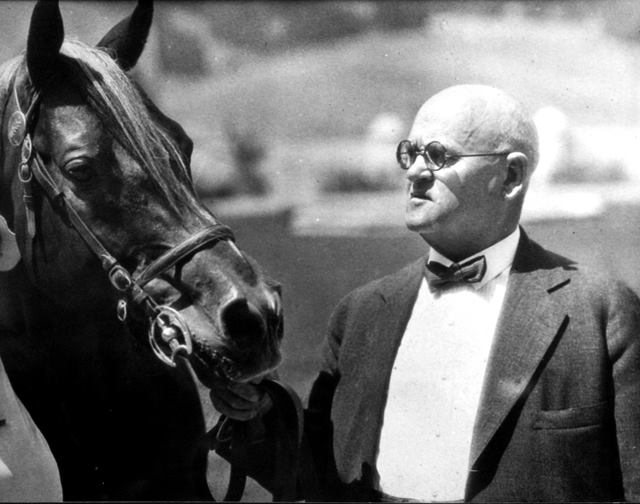
Of these, Jadaan (pictured above) and the mares Fasal (*Hamrah/Amran, she by *Deyr/*Wadduda) and the mares Fasal (*Hamrah/Amran, she by *Deyr/*Wadduda) and Killah (*Gomusa/*Hadba) were to produce foals which survived into current Davenport pedigrees.
The old stallion *Deyr was also part of the group, but did not live to sire foals for Kellogg.
Kellogg's next purchase was in December of the same year. This group from the Diamond Bar Ranch included the stallions Letan and Antez (pictured above), and the mares Hasiker and Tamarinsk. Tamarinsk had been in foal to Letan, and died shortly after producing a filly in 1926.

Raised on a milk goat, the filly was named Babe Azab (pictured above). According to notes of Carl Raswan's, "Azab" is an Arabic word denoting a mare which follows the milk camel.
Several of the Davenport horses later acquired for the ranch are also ancestors of living Davenports. The Lewis bred mare Schilla (Letan/*Saleefy) came from Harry M. Wegeforth in 1928. In 1929 Kellogg purchased a group from Charles W. Jewett of Indianapolis, which included Hanad (pictured below), his dam Sankirah, Poka, and Saba.

Saba arrived at the ranch in foal to Hanad, producing in 1930 the stallion Sanad. The Kellogg Ranch also owned the Lewis bred stallion Dhareb (Letan/Moliah) for a short time, apparently acting as agents in his sale.
While at the Kellogg Ranch horses of 100 percent Davenport bloodlines were trained and shown extensively, bred to each other, and bred to virtually every other bloodline at the ranch as well.
Though Davenport horses had generally arrived in Pomona in large groups, they tended to leave one at a time, scattering as widely as the rest of the horses sold from the Kellogg Ranch. After leaving the ranch, Antez, Dhareb, Poka, Hanad, and Sanad gave nine key Davenport foals.
Beyond these, modern Davenport breeding depends on 100 percent Davenport foals bred by Kellogg's:
- Kasar 1929 stallion (Letan/Fasal)
- Schilan 1929 mare (Antez/Schilla) (All Lewis)
- Salan 1930 stallion (Antez/Fasal)
- Anlah 1930 mare (Antez/Killah)
- Badia 1930 mare (Jadaan/Babe Azab)
- Antarah 1931 mare (Antez/Hasiker) (all Lewis)
We can "tag" various historic Davenports with the name of the party which purchased them from Hingham, and designate three basic elements incorporated in modern Davenport pedigrees: "Lewis," "Winant," and "Clarke." there is some logic to this designation process.
Each of the three purchases was sizeable, and each represented the selections of the "eye" of some human purchaser, who must have made an effort to review the available Hingham horses and choose from among them according to his or her taste. In the same way the "eyes" of two men - Davenport and Haffez - put together the 1906 Davenport importation from Arabia.
Far more than a random boatload of Arabian horses, the Davenport importation necessarily reflected the tastes of the men who assembled it. In this context, "straight Davenport" breeding makes more sense than certain other kinds of straight pedigree breeding.
Noteworthy is the fact that the "second foundation" stallion Tripoli (Hanad/Poka) was all Winant, while the full siblings Dharanah, El Alamein, Dharebah, and Dharantez (Dhareb/Antarah) were all Lewis.
The markedly Kuhaylan influences of Letan, *Reshan, and *Werdi came only through Lewis breeding. The Winant animals Hanad, Tripoli, and Sanad are all extreme Saqlawi influences.
As one might expect, nearly every living Davenport traces to all three elements. However, those living Davenports not tracing to Fasal have pedigrees incorporating only "Lewis" and "Winant" animals.
With two exceptions, these animals are concentrated on the hands of Joyce Hampshire and Craver Farms. Another group does not trace to any Winant animals, descending only from the "Old California" (in California before the Kellogg Ranch), Davenports.
The pedigrees of these horses lack Hanad. All of the latter are at Craver Farms.
To understand the history of the Davenport breeding group is to gain an insight into Davenport horses alive today. The Kellogg Ranch was a key factor in the continuity of the bloodlines.
ACKNOWLEDGEMENTS (note, these are from the original print of the article and may or may not match the actual photos shared in this online version):
The author would like to thank Ralph Clark of the Arabian Horse Registry for his assistance in research.
Great thanks are also due to the staff of the Arabian Horse Trust, in particular archivist Ruth Boyd for her efforts to aid my research on the Davenport topic.
Especially appreciated is the Trust's permission to use the photographs of Hanad, Jadaan, Sakavez, and Pep, which are part of the Sturm Collection held by the Arabian Horse Trust.
Sincere gratitude must also be expressed to Melissa J. Paul of the W.K. Kellogg Arabian Horse Library at Cal Poly Pomona, for her help in my perusal of the Kellogg Ranch Papers.
Correspondence quoted from the Alice L. Payne Collection appears courtesy of Joyce Hampshire.
The photograph of Antez appears courtesy of Craver Farms.
Comments
No Comments