
By April Crowe
** Originally published in July-August-September 1994 Abu Farwa issue of the Crabbet Influence.
My grandparents came to the United States in the early 1900s along with the huge wave of immigrants that were seeking new and better lives. I feel fortunate to have the insights and experiences that go with being raised by two vastly different families (my mother is Sicilian, my father Swedish).
It gave me a unique perspective on people and compelled me to think about the profound differences in cultures and the individuals that created them. I also recognize the basic traits we all share as humans.
I grew up in New York City and in Long Island's sprawling suburbs. I still do not understand how a life-long love and obsession can be an instantaneous revelation, especially at such a young age, but the first time I got close enough to a pony to see, touch, and smell him, I was hooked.
I was two or three years old. Something about that special moment set a course for my entire life, and I sensed from that day forward horses would be my "reason for living."
Of course I rarely got to be near horses, so made do with plastic horses and shoe box stables, scrapbooks of any horse picture or article I could find, and T.V. movies such as National Velvet or My Friend Flicka. My imagination was active, and it "kept me going" all of the years that I couldn't be around horses. I knew that someday I would be, and that was o.k.
Later on, after suffering through public school, I tried college, joined the Army, became a Medical Corpsman, and hitch-hiked across the west. I experienced jobs ranging from large/small animal Veterinary Assistant, to waitressing, farm worker to kennel manager.
Still, horses were my number 1 love and I became especially fond of Morgan horses - the classic old type with predominately Lippit blood. They were tough, beautiful, spirited but tractable, and able to do a hard days work.
In the early 70s I was able to secure a job at a Morgan breeding farm in North Carolina not long after I got married. This farm bred almost exclusively for showing (mostly halter, English and Western pleasure, etc.), and it gave me my first bitter taste of how much harm, physically and mentally, could be inflicted upon such noble creatures all for trophies and ribbons!
Showing had never interested me, and by the time I left that farm, I was confirmed in my aversion toward showing. Since then I have never been able to see the "sense" of it all.
We moved to Kansas where my husband Jeff was employed as a curator-keeper of a small zoo. For us, Kansas had its beauty, but it was too hard and too flat. We craved trees, mountains and streams, and a place where land was abundant and priced within our reach.
From a few photos gleaned from books and magazines, and a copy of the West Virginia Market Bulletin in our hands, we left for "The Mountain State." That was 20 years ago, and although things haven't always been easy, we will always be glad we came and stayed.
I had always had a fascination with long-distance riding but realized by 1973 that Morgan horses weren't exactly dominating the then young sport of organized endurance riding. Even though there weren't many purebred Arabians at the time, purebreds and part-breds were finishing and winning the few rides that there were.
I tried to stay true to my first love, the Morgan, but those darn Arab names kept cropping up in the ride results!
I knew very little about the Arabian horse (being the "foreign and exotic import" he was!) I never imagined him being a horse I could have any interest in, but I was never any good at fooling myself either, so I just jumped (or should I say "waded") in to the world of Arabian horses.
At this point, sad to say, I had never even been to a ride or (knowingly) had seen a live endurance horse or Arabian! With the extremely limited amount of resources and information I had available to me at the time, I began gathering names of parents and grandparents of these horses.
I didn't know about stud books or that they even existed. I was pretty darn ignorant about the Arabian horse - still, I combed through the ride results and endurance publications and devoured the few books and breed magazines that came my way. I detected in the pedigrees of the horses I studied the same names over and over.
This was very exciting to me - there was a rhyme and reason to this game after all! The horses names that stood out were Gulastra, Alla Amarward, *Fadl, Antez, *Sulejman, *Zarife, *Witez II, *Mirage, Abu Farwa, *Nasr, Errabi, *Nasik, *Farasin, Ribal, *Nureddin II and *Malouma.
Of course, there were others but these seemed to predominate.
By the mid 70s I was fortunate to meet a friend - Laurie Jurs, also an avid endurance rider, who had already done a few rides. Together we conditioned our horses and competed in rides for a few years. (During this time I managed a boarding, training, sales stable.)
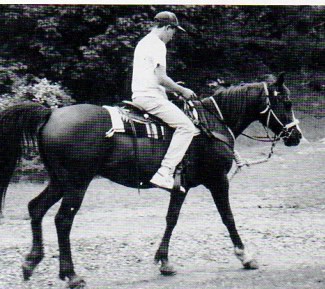
Though Arabians were scarce in West Virginia, I managed to find a little 14.2 hand chestnut gelding named Cianan.
Shortly after training him as a five year old we were going to and completing rides. He had all the lines to horses I loved and was a tough little guy. Then we bought our own farm.
Because of other responsibilities such as two small children, a milk cow and calves, 40 or 50 head of ewes and their lambs, wood stoves to feed, etc., etc., I could only condition Cianan lightly.
Nonetheless he always did his best and I never had a serious health or soundness problem with him. He was always ready for more miles. (He remained in endurance most of his life until 2 years ago when at the age of 19 years I "found" him and bought him back.)
He's still sound and healthy after thousands of miles, has a sense of humor and looks like he's 10 years old. He is ridden frequently to this day.
I bred a couple of horses in the 70s, but it wasn't until the early 80s that I began in earnest to acquire and breed the horses I loved. I've had many setbacks (what breeder hasn't?), but I took it all as a learning proposition.
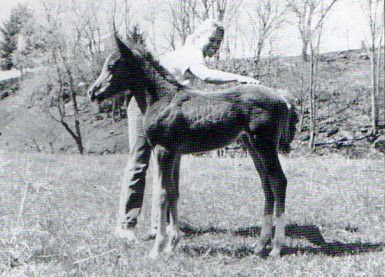
By the mid 80s the sad, inevitable but true fact was that much of the "old domestic" lines I sought had already become heavily infused with blood from the newer "in vogue" imports. I moved quickly to find horses with the specific breeding I needed.
I can only hope that a good variety of the "old lines" are still being nurtured, protected and preserved by people who care. I believe there are.
Today at Cold Knob Farm, there live 30+ head of registered Arabians, bred strictly on the proven endurance bloodlines of early American breeding programs such as Babson, Brown, Travelers Rest, Selby, Kellogg and others. All are well cared for and handled but don't know the word "pamper".
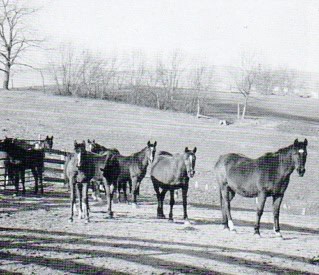
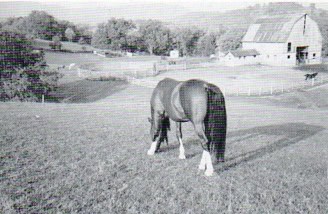
They run free and together in family-type groups over 105 acres of steep to rolling land. They traverse mud, rocks, and streams and are exposed to all of the vagaries of weather, fair and foul.
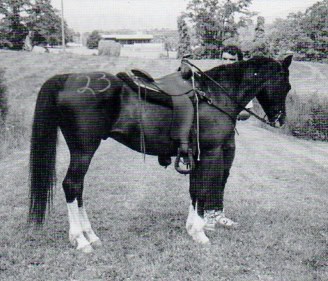
I am continually amazed at the degree of vitality, health, and soundness they exhibit. A veterinarian is an uncommon visitor here.
It is rewarding to me in many ways to maintain this special group of animals, and I feel fortunate to have had the chance to live my dream.
(Editor's note: April has informed me that since writing this article, she has decided to disperse her herd due to reasons beyond her control. Please contact her for pedigrees and further information.)
**All of the articles included in the re-launched Crabbet.com site from the original website, Georgia Cheer, Silver Monarch Publishing and The Crabbet Influence magazine are shared here with permission of Georgia Cheer given May 16, 2012.**
Comments
No Comments